KIDNEY STONES TREATMENT
Safe & Advanced Kidney Stone Treatment in Tamil Nadu
Book a Free Consultation. Choose the Right Hospital.
Whether you're experiencing kidney stone pain, painful urination, blood in the urine, or recurring stones, our Surgery Care Coordinators help you connect with the right urologist and hospital. From consultation and diagnosis to treatment coordination and recovery support, we help make your kidney stone journey simpler.
Whether you're experiencing kidney stone pain, painful urination, blood in the urine, or recurring stones, our Surgery Care Coordinators help you connect with the right urologist and hospital. From consultation and diagnosis to treatment coordination and recovery support, we help make your kidney stone journey simpler.
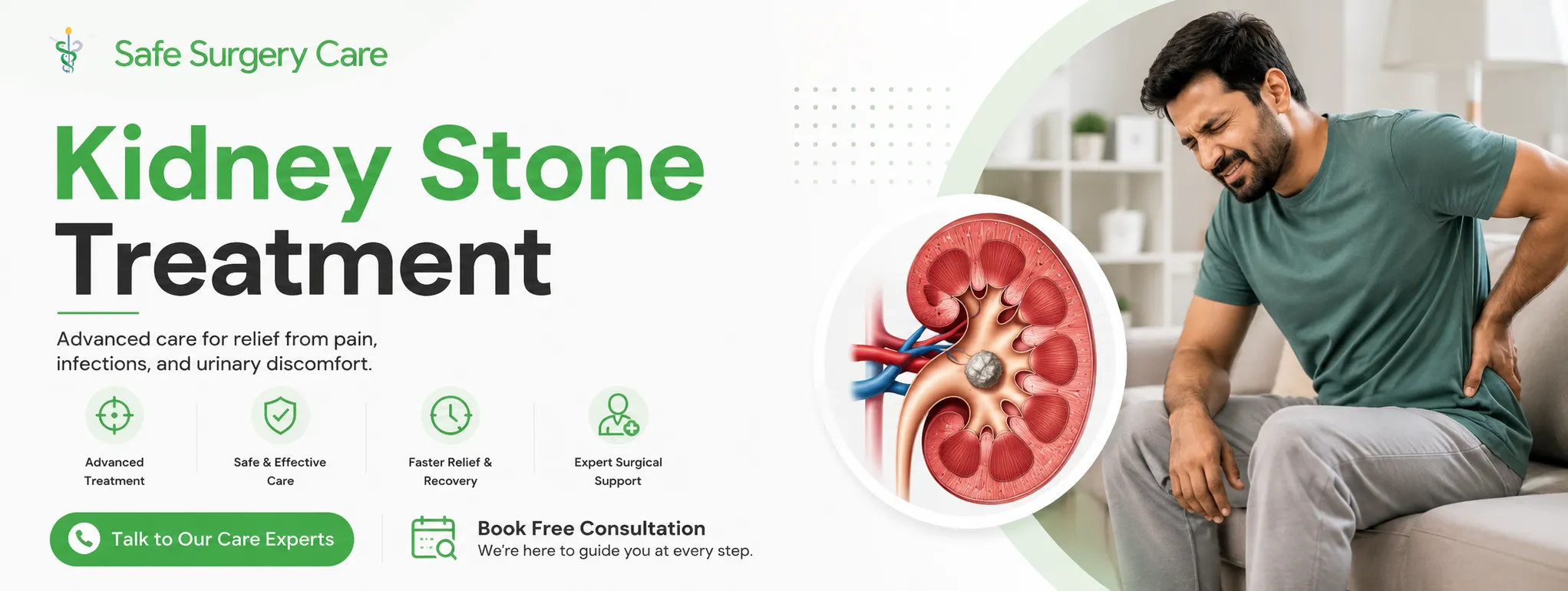
Understanding the Condition
What are Kidney Stones?
Kidney stones are hard, crystal-like deposits that form inside the kidneys when certain minerals and salts in the urine become concentrated. They can remain in the kidney or move into the ureter, sometimes causing severe pain and difficulty passing urine.
Kidney stones can cause symptoms such as sharp pain in the back or side, pain that moves towards the lower abdomen or groin, painful urination, frequent urination, nausea, vomiting, or blood in the urine. Some smaller stones may pass naturally, while larger or obstructing stones may require medical treatment.
Depending on the stone's size, location, and your overall health, treatment may range from medicines and observation to procedures such as shock wave lithotripsy, ureteroscopy with laser treatment, or PCNL.
Kidney stones are hard, crystal-like deposits that form inside the kidneys when certain minerals and salts in the urine become concentrated. They can remain in the kidney or move into the ureter, sometimes causing severe pain and difficulty passing urine.
Kidney stones can cause symptoms such as sharp pain in the back or side, pain that moves towards the lower abdomen or groin, painful urination, frequent urination, nausea, vomiting, or blood in the urine. Some smaller stones may pass naturally, while larger or obstructing stones may require medical treatment.
Depending on the stone's size, location, and your overall health, treatment may range from medicines and observation to procedures such as shock wave lithotripsy, ureteroscopy with laser treatment, or PCNL.
Problems With the Foreskin
Common Types of Kidney Stones
Calcium Stones
The most common type of kidney stone, usually made from calcium oxalate or calcium phosphate. They can form when certain substances become concentrated in the urine.
The most common type of kidney stone, usually made from calcium oxalate or calcium phosphate. They can form when certain substances become concentrated in the urine.
The most common type of kidney stone, usually made from calcium oxalate or calcium phosphate. They can form when certain substances become concentrated in the urine.
Uric Acid Stones
These stones can develop when urine contains too much uric acid. They may be associated with dehydration, certain dietary patterns, or conditions that increase uric acid levels.
These stones can develop when urine contains too much uric acid. They may be associated with dehydration, certain dietary patterns, or conditions that increase uric acid levels.
These stones can develop when urine contains too much uric acid. They may be associated with dehydration, certain dietary patterns, or conditions that increase uric acid levels.
Struvite Stones
These stones are often associated with urinary tract infections. They can sometimes grow quickly and may become large if the underlying infection is not treated.
These stones are often associated with urinary tract infections. They can sometimes grow quickly and may become large if the underlying infection is not treated.
These stones are often associated with urinary tract infections. They can sometimes grow quickly and may become large if the underlying infection is not treated.
Cystine Stones
A less common type caused by a hereditary condition called cystinuria, which causes excess cystine to enter the urine and form stones.
A less common type caused by a hereditary condition called cystinuria, which causes excess cystine to enter the urine and form stones.
A less common type caused by a hereditary condition called cystinuria, which causes excess cystine to enter the urine and form stones.
At Safe Surgery Care, we help you connect with the right specialist and hospital for evaluation and treatment. Your surgeon will determine whether medicines, other non-surgical treatment, or circumcision is appropriate for your condition.
At Safe Surgery Care, we help you connect with the right specialist and hospital for evaluation and treatment. Your surgeon will determine whether medicines, other non-surgical treatment, or circumcision is appropriate for your condition.
KNOW THE SIGNS
Symptoms & Causes
Common Symptoms
Sharp pain in the back or side
Pain that may move toward the lower abdomen or groin
Pain or burning while urinating
Frequent or urgent need to urinate
Blood in the urine
Nausea or vomiting
Cloudy or foul-smelling urine
Fever or chills, which may indicate an infection
Common Causes
Not drinking enough fluids
Dehydration or excessive sweating
High salt intake
Certain dietary patterns
Family history of kidney stones
Previous kidney stones
Obesity or being overweight
Certain medical conditions
Recurrent urinary tract infections
Certain medicines or metabolic conditions
Common Symptoms
Sharp pain in the back or side
Pain that may move toward the lower abdomen or groin
Pain or burning while urinating
Frequent or urgent need to urinate
Blood in the urine
Nausea or vomiting
Cloudy or foul-smelling urine
Fever or chills, which may indicate an infection
Common Causes
Not drinking enough fluids
Dehydration or excessive sweating
High salt intake
Certain dietary patterns
Family history of kidney stones
Previous kidney stones
Obesity or being overweight
Certain medical conditions
Recurrent urinary tract infections
Certain medicines or metabolic conditions
DIAGNOSIS
How Doctors Diagnose Kidney Stones
A doctor first evaluates your symptoms, medical history, and physical condition to determine whether kidney stones may be causing your symptoms. This may be followed by urine and blood tests and imaging to identify the stone and assess its size and location.
Imaging tests such as an ultrasound, X-ray, or CT scan may be recommended depending on your symptoms and clinical situation. These tests can help doctors check for the number and size of stones, their location, and whether a stone is blocking the flow of urine.
Kidney stones do not always require surgery. Depending on the stone's size, location, symptoms, and whether it is causing an obstruction or other complications, your doctor may recommend observation, medicines, or a procedure to remove or break the stone.
A doctor first evaluates your symptoms, medical history, and physical condition to determine whether kidney stones may be causing your symptoms. This may be followed by urine and blood tests and imaging to identify the stone and assess its size and location.
Imaging tests such as an ultrasound, X-ray, or CT scan may be recommended depending on your symptoms and clinical situation. These tests can help doctors check for the number and size of stones, their location, and whether a stone is blocking the flow of urine.
Kidney stones do not always require surgery. Depending on the stone's size, location, symptoms, and whether it is causing an obstruction or other complications, your doctor may recommend observation, medicines, or a procedure to remove or break the stone.
A doctor first evaluates your symptoms, medical history, and physical condition to determine whether kidney stones may be causing your symptoms. This may be followed by urine and blood tests and imaging to identify the stone and assess its size and location.
Imaging tests such as an ultrasound, X-ray, or CT scan may be recommended depending on your symptoms and clinical situation. These tests can help doctors check for the number and size of stones, their location, and whether a stone is blocking the flow of urine.
Kidney stones do not always require surgery. Depending on the stone's size, location, symptoms, and whether it is causing an obstruction or other complications, your doctor may recommend observation, medicines, or a procedure to remove or break the stone.
When to Consult a doctor:
Consider consulting a qualified doctor if you experience severe or persistent pain in your back or side, blood in the urine, painful urination, repeated kidney stone symptoms, nausea or vomiting, or difficulty passing urine.
If you have kidney stone symptoms along with fever or chills, seek prompt medical attention, as this may indicate an infection that requires urgent evaluation.
Consider consulting a qualified doctor if you experience severe or persistent pain in your back or side, blood in the urine, painful urination, repeated kidney stone symptoms, nausea or vomiting, or difficulty passing urine.
If you have kidney stone symptoms along with fever or chills, seek prompt medical attention, as this may indicate an infection that requires urgent evaluation.
Consider consulting a qualified doctor if you experience severe or persistent pain in your back or side, blood in the urine, painful urination, repeated kidney stone symptoms, nausea or vomiting, or difficulty passing urine.
If you have kidney stone symptoms along with fever or chills, seek prompt medical attention, as this may indicate an infection that requires urgent evaluation.
Laser Kidney Stone Treatment
Laser Kidney Stone Treatment for Effective Stone Removal
Laser kidney stone treatment is a minimally invasive procedure used to break kidney or ureter stones into smaller fragments using a specialised laser. The procedure is commonly performed through the urinary passage, without a large external incision.
It may be considered when a stone is unlikely to pass naturally, causes persistent pain or blockage, or requires active removal. Your urologist will determine whether laser treatment is suitable based on the stone's size, location, number, symptoms, and your overall health.
Compared with some conventional surgical approaches, laser treatment may allow the stone to be treated through a minimally invasive approach with less external tissue disruption. However, the most appropriate treatment varies from patient to patient and should be decided by a qualified urologist.
Laser kidney stone treatment is a minimally invasive procedure used to break kidney or ureter stones into smaller fragments using a specialised laser. The procedure is commonly performed through the urinary passage, without a large external incision.
It may be considered when a stone is unlikely to pass naturally, causes persistent pain or blockage, or requires active removal. Your urologist will determine whether laser treatment is suitable based on the stone's size, location, number, symptoms, and your overall health.
Compared with some conventional surgical approaches, laser treatment may allow the stone to be treated through a minimally invasive approach with less external tissue disruption. However, the most appropriate treatment varies from patient to patient and should be decided by a qualified urologist.
Laser kidney stone treatment is a minimally invasive procedure used to break kidney or ureter stones into smaller fragments using a specialised laser. The procedure is commonly performed through the urinary passage, without a large external incision.
It may be considered when a stone is unlikely to pass naturally, causes persistent pain or blockage, or requires active removal. Your urologist will determine whether laser treatment is suitable based on the stone's size, location, number, symptoms, and your overall health.
Compared with some conventional surgical approaches, laser treatment may allow the stone to be treated through a minimally invasive approach with less external tissue disruption. However, the most appropriate treatment varies from patient to patient and should be decided by a qualified urologist.
How The Procedure Works
Medical evaluation and imaging are performed to assess the stone's size and location.
Anaesthesia is administered as recommended by the treating medical team.
A thin specialised instrument is guided through the urinary passage toward the stone.
A laser is used to break the stone into smaller fragments.
The fragments are removed or allowed to pass naturally, depending on the treatment plan.
A temporary ureteral stent may be placed when clinically required.
The treated area is checked before completing the procedure.
Medical evaluation and imaging are performed to assess the stone's size and location.
Anaesthesia is administered as recommended by the treating medical team.
A thin specialised instrument is guided through the urinary passage toward the stone.
A laser is used to break the stone into smaller fragments.
The fragments are removed or allowed to pass naturally, depending on the treatment plan.
A temporary ureteral stent may be placed when clinically required.
The treated area is checked before completing the procedure.
Potential Benefits
Minimally Invasive Approach
Effective Stone Fragmentation
No Large External Incision
Selected Kidney & Ureter Stones
Potentially Faster Recovery
Confused About Your Treatment, Costs, or Recovery? Get Clear, Patient-First Guidance from Our Surgery Care Coordinators.
Confused About Your Treatment, Costs, or Recovery? Get Clear, Patient-First Guidance from Our Surgery Care Coordinators.
Confused About Your Treatment, Costs, or Recovery? Get Clear, Patient-First Guidance from Our Surgery Care Coordinators.
Alternative Kidney Stone Removal Methods
Alternative Kidney Stone Removal Methods
1. ESWL — Shock Wave Therapy
A non-invasive treatment that uses focused shock waves to break selected kidney stones into smaller fragments. The fragments can then pass naturally through the urine.
Best suited for certain small to medium-sized stones, depending on their size, location, and the patient’s condition.
A non-invasive treatment that uses focused shock waves to break selected kidney stones into smaller fragments. The fragments can then pass naturally through the urine.
Best suited for certain small to medium-sized stones, depending on their size, location, and the patient’s condition.
URSL — Ureteroscopy with Laser
A thin scope is guided through the urinary tract to reach a stone in the ureter. A laser is used to break the stone into smaller fragments, which can then be removed or passed naturally.
No external incision is usually required.
A thin scope is guided through the urinary tract to reach a stone in the ureter. A laser is used to break the stone into smaller fragments, which can then be removed or passed naturally.
No external incision is usually required.
3. RIRS — Retrograde Intrarenal Surgery
A flexible scope is guided through the urinary tract into the kidney to locate and treat selected kidney stones using a laser.
It may be considered for stones that are difficult to reach or are not suitable for other treatment approaches.
A flexible scope is guided through the urinary tract into the kidney to locate and treat selected kidney stones using a laser.
It may be considered for stones that are difficult to reach or are not suitable for other treatment approaches.
4. PCNL — Percutaneous Nephrolithotomy
A minimally invasive procedure generally used for larger or complex kidney stones.
A small access tract is created through the back to reach the kidney and remove or fragment the stone. It may be recommended when the stone burden is too large for other treatment options.
A minimally invasive procedure generally used for larger or complex kidney stones.
A small access tract is created through the back to reach the kidney and remove or fragment the stone. It may be recommended when the stone burden is too large for other treatment options.
Confused About Your Treatment, Costs, or Recovery? Get Clear, Patient-First Guidance from Our Surgery Care Coordinators.
Confused About Your Treatment, Costs, or Recovery? Get Clear, Patient-First Guidance from Our Surgery Care Coordinators.
STEP BY STEP
Your Treatment Process
1
Pre-Surgery Consultation
A detailed consultation with a qualified urologist to understand your symptoms, medical history, scan reports, stone size and location, and the treatment options suitable for you.
A detailed consultation with a qualified urologist to understand your symptoms, medical history, scan reports, stone size and location, and the treatment options suitable for you.
2
Before Surgery
Complete the required medical evaluation, review your medications and test results, follow fasting instructions if advised, and prepare for your hospital visit and procedure.
Complete the required medical evaluation, review your medications and test results, follow fasting instructions if advised, and prepare for your hospital visit and procedure.
3
During Surgery
The selected kidney stone treatment is performed by a qualified urologist using an appropriate technique, such as ESWL, URSL, RIRS, or PCNL, based on your stone and medical condition.
The selected kidney stone treatment is performed by a qualified urologist using an appropriate technique, such as ESWL, URSL, RIRS, or PCNL, based on your stone and medical condition.
4
After Surgery
Receive prescribed medicines, hydration and activity guidance, stent-related instructions if applicable, recovery advice, and follow-up support to help you recover safely.
Receive prescribed medicines, hydration and activity guidance, stent-related instructions if applicable, recovery advice, and follow-up support to help you recover safely.
RECOVERY TIMELINE
What Recovery Looks Like
Recovery after kidney stone treatment varies depending on the procedure, stone size and location, and your overall health. Your urologist will provide a personalised recovery plan.
Recovery after kidney stone treatment varies depending on the procedure, stone size and location, and your overall health. Your urologist will provide a personalised recovery plan.
Day 1
Rest, follow prescribed medications, stay hydrated as advised, and monitor for any discomfort or urinary symptoms after the procedure.
Rest, follow prescribed medications, stay hydrated as advised, and monitor for any discomfort or urinary symptoms after the procedure.
Day 3
Pain and urinary discomfort may gradually improve. Follow your doctor’s activity and hydration instructions and continue prescribed medicines.
Pain and urinary discomfort may gradually improve. Follow your doctor’s activity and hydration instructions and continue prescribed medicines.
Day 5
Many patients gradually return to light daily activities, depending on the procedure and how they are recovering. Continue follow-up care as advised.
Many patients gradually return to light daily activities, depending on the procedure and how they are recovering. Continue follow-up care as advised.
Day 7
Recovery may be progressing well, with many patients returning toward their normal routine. Your recovery time may vary, especially if a stent or additional treatment is required.
Recovery may be progressing well, with many patients returning toward their normal routine. Your recovery time may vary, especially if a stent or additional treatment is required.
At Safe Surgery Care, our Surgery Care Coordinators can help coordinate your consultation, hospital visit, and follow-up throughout your treatment journey.
At Safe Surgery Care, our Surgery Care Coordinators can help coordinate your consultation, hospital visit, and follow-up throughout your treatment journey.
STAY INFORMED
Risks & Prevention
Possible Risks
• Temporary pain or discomfort
• Blood in the urine
• Urinary discomfort or increased frequency
• Infection
• Residual stone fragments
• Ureter irritation or injury
• Stent-related discomfort, if a stent is placed
• Stone recurrence
• Requiring additional treatment in some cases
• Reactions related to anaesthesia
Temporary Pain Or Minor Bleeding
Temporary Difficulty Urinating
Infection At The Surgical Site
Delayed Wound Healing
Mild Swelling Or Discomfort
Anal Narrowing (Rare)
Recurrence Of Piles
Anaesthesia-Related Reactions
Prevention Tips
• Drink enough fluids as advised by your doctor
• Follow dietary recommendations based on your stone type
• Reduce excessive salt intake
• Maintain a healthy body weight
• Take prescribed medicines as directed
• Follow your doctor’s advice for preventing recurrent stones
• Attend recommended follow-up appointments
• Complete stone analysis when advised
• Monitor for recurring urinary symptoms
• Seek medical advice if you develop severe pain, fever, chills, vomiting, or difficulty passing urine
Eat A Fibre-Rich Diet Daily
Drink Plenty Of Water
Avoid Straining During Bowel Movements
Do Not Delay Passing Stools
Stay Physically Active
Avoid Prolonged Sitting
Maintain Good Anal Hygiene
Follow Your Surgeon's Instructions
For patients with a history of kidney stones, adopting healthy fluid and dietary habits may help reduce the risk of developing stones again. Preventive measures should be based on the type of stone, medical history, and your doctor’s recommendations. Regular follow-up can also help identify and manage factors that may increase the risk of recurrence.
For patients with a history of kidney stones, adopting healthy fluid and dietary habits may help reduce the risk of developing stones again. Preventive measures should be based on the type of stone, medical history, and your doctor’s recommendations. Regular follow-up can also help identify and manage factors that may increase the risk of recurrence.
transparent pricing
Transparent Pricing & Payment Options
Circumcision Surgery Cost In Tamil Nadu
The cost of kidney stone treatment depends on the treatment method, stone size and location, hospital, urologist, anaesthesia, diagnostic tests, hospital stay, and any additional care required. Since treatment needs vary from patient to patient, an accurate estimate can usually be provided after consultation and evaluation.
The cost of kidney stone treatment depends on the treatment method, stone size and location, hospital, urologist, anaesthesia, diagnostic tests, hospital stay, and any additional care required. Since treatment needs vary from patient to patient, an accurate estimate can usually be provided after consultation and evaluation.
Cash Payment Options
We help you understand the expected treatment cost and payment process before treatment. Our Surgery Care Coordinators can help clarify the hospital’s payment requirements, available payment options, and applicable charges so you can plan your treatment with greater confidence.
We help you understand the expected treatment cost and payment process before treatment. Our Surgery Care Coordinators can help clarify the hospital’s payment requirements, available payment options, and applicable charges so you can plan your treatment with greater confidence.
Insurance & Cashless Treatment
Kidney stone treatment may be covered by health insurance depending on your policy, medical necessity, waiting periods, exclusions, and the terms of your insurer.
We help you understand the required documentation and coordinate the cashless process at eligible hospitals. Final approval and coverage are determined by your insurance provider and policy.
Kidney stone treatment may be covered by health insurance depending on your policy, medical necessity, waiting periods, exclusions, and the terms of your insurer.
We help you understand the required documentation and coordinate the cashless process at eligible hospitals. Final approval and coverage are determined by your insurance provider and policy.
EMI OPTIONS
Depending on the hospital and available financing partners, EMI or healthcare financing options may be available for eligible patients.
We can help you understand the estimated treatment cost and available payment options before proceeding. Actual eligibility, financing terms, and approval depend on the hospital, financing provider, and applicable terms.
Depending on the hospital and available financing partners, EMI or healthcare financing options may be available for eligible patients.
We can help you understand the estimated treatment cost and available payment options before proceeding. Actual eligibility, financing terms, and approval depend on the hospital, financing provider, and applicable terms.
Why Choose Safe Surgery Care
Trusted Care Co-ordination, End To End
Safe Surgery Care is your trusted surgery care partner, helping you connect with experienced surgeons and verified hospitals across your city in Tamil Nadu. We simplify every step of your surgical journey by helping you compare treatment options, schedule consultations, understand insurance benefits, and coordinate your care with complete transparency.
Our dedicated Surgery Care Coordinators stay with you throughout the process—from your first enquiry to post-surgery follow-up—ensuring clear communication, timely appointment scheduling, and personalized support. With access to trusted hospital partners, advanced treatment options, and patient-first guidance, we make your surgery experience smoother, more informed, and less stressful.
Safe Surgery Care is your trusted surgery care partner, helping you connect with experienced surgeons and verified hospitals across your city in Tamil Nadu. We simplify every step of your surgical journey by helping you compare treatment options, schedule consultations, understand insurance benefits, and coordinate your care with complete transparency.
Our dedicated Surgery Care Coordinators stay with you throughout the process—from your first enquiry to post-surgery follow-up—ensuring clear communication, timely appointment scheduling, and personalized support. With access to trusted hospital partners, advanced treatment options, and patient-first guidance, we make your surgery experience smoother, more informed, and less stressful.
Why Patients Choose Safe Surgery Care
Trusted Hospitals & Experienced Surgeons
Dedicated Surgery Care Coordinator
Advanced Minimally Invasive Treatment Options
Faster Consultation & Surgery Scheduling
Insurance & Cashless Assistance
Easy EMI Options (Where Available)
Transparent Treatment Guidance
Pre & Post Surgery Support
Personalized Hospital Comparison
Support Across Your City in Tamil Nadu
One Point of Contact Throughout Your Journey
Patient-First Care Every Step of the Way
Why Patients Choose Safe Surgery Care
Trusted Hospitals & Experienced Surgeons
Dedicated Surgery Care Coordinator
Advanced Minimally Invasive Treatment Options
Faster Consultation & Surgery Scheduling
Insurance & Cashless Assistance
Easy EMI Options (Where Available)
Transparent Treatment Guidance
Pre & Post Surgery Support
Personalized Hospital Comparison
Support Across Your City in Tamil Nadu
One Point of Contact Throughout Your Journey
Patient-First Care Every Step of the Way
Why Patients Choose Safe Surgery Care?
Trusted Hospitals & Experienced Surgeons
Dedicated Surgery Care Coordinator
Advanced Minimally Invasive Treatment Options
Faster Consultation & Surgery Scheduling
Insurance & Cashless Assistance
Easy EMI Options (Where Available)
Transparent Treatment Guidance
Pre & Post Surgery Support
Personalized Hospital Comparison
Support Across Your City in Tamil Nadu
One Point of Contact Throughout Your Journey
Patient-First Care Every Step of the Way
Confused About Your Treatment, Costs, or Recovery? Get Clear, Patient-First Guidance from Our Surgery Care Coordinators.
Confused About Your Treatment, Costs, or Recovery? Get Clear, Patient-First Guidance from Our Surgery Care Coordinators.
how we help
Your Treatment Journey
Our role extends beyond appointment booking — we support you before, during, and after treatment.
Our role extends beyond appointment booking — we support you before, during, and after treatment.
1
Share Your Symptoms
Speak with a Care Navigator about your condition.
Speak with a Care Navigator about your condition.
2
Understand Your Options
Receive clear information about suitable treatment approaches.
Receive clear information about suitable treatment approaches.
3
Get Matched
Connect with a verified hospital and experienced surgeon based on your location and medical needs.
Connect with a verified hospital and experienced surgeon based on your location and medical needs.
4
We Coordinate Everything
We assist with appointments, documentation, hospital admission, Insurance and EMI support.
We assist with appointments, documentation, hospital admission, Insurance and EMI support.
5
Recovery Support
Our team stays connected after surgery to ensure your recovery progresses smoothly.
Our team stays connected after surgery to ensure your recovery progresses smoothly.
PATIENT FAQ
Frequently Asked Questions About Piles Treatment
Explore answers to common questions before your consultation or surgery. Need more help? Our Care Coordinators are here for you.
Explore answers to common questions before your consultation or surgery. Need more help? Our Care Coordinators are here for you.
How soon can I get a consultation?
Most patients get connected to a specialist within 24 hours of reaching out. Urgent cases are prioritized and can often be seen the same day.
Is Laser Kidney Stone Surgery a Day Care Procedure?
Do you help with insurance and EMI?
Do I need to travel for surgery?
Are there any hidden costs?
Get Your Free Estimate
We respect your privacy | Privacy Policy
Get Your Free Estimate
We respect your privacy | Privacy Policy