Stapler Circumcision in Chennai: Procedure, Benefits & Cost
Circumcision
•
3 min read
Stapler Circumcision in Chennai: Procedure, Benefits & Cost
Learn how to pack efficiently, protect fragile items, and stay organized before moving day so nothing gets left behind.
Safe Surgery Care
Medical Expert
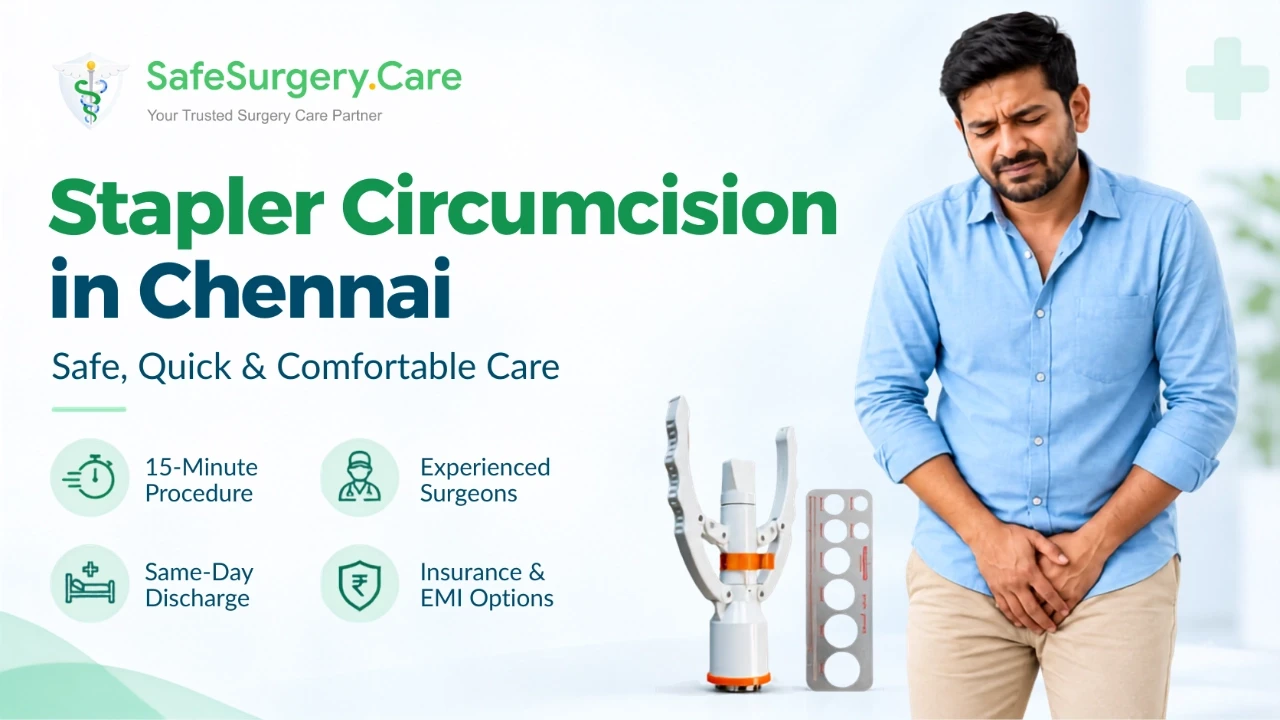
Stapler Circumcision in Chennai: Procedure, Benefits, Risks, Recovery & Cost Factors
Quick Answer:
Stapler circumcision is a device-assisted method of circumcision in which a specialized surgical device is used to remove excess foreskin and help control bleeding and wound closure. It may be considered for adults with problems such as a tight foreskin, recurrent foreskin infections, or other medical indications. Whether stapler circumcision is appropriate depends on the individual's condition, anatomy, medical history, and a doctor's assessment.
Introduction
Problems involving the foreskin can be uncomfortable and sometimes affect everyday activities, urination, sexual activity, or personal hygiene.
One condition that commonly leads people to seek medical advice is phimosis, where the foreskin is too tight to retract comfortably or normally. Other concerns can include repeated inflammation or infection of the foreskin, pain during erections, difficulty retracting the foreskin, or scarring.
For some patients, circumcision may be recommended when conservative treatment is unsuccessful or when surgery is considered the most appropriate option.
Stapler circumcision is one type of device-assisted circumcision that some adults may consider. Because different circumcision techniques and devices work differently, it is important to understand the procedure, potential advantages, limitations, recovery, risks, and questions to ask before making a decision.
This guide explains what patients considering stapler circumcision in Chennai should know.
What Is Stapler Circumcision?
Stapler circumcision is a surgical technique that uses a specialized circumcision device to remove the foreskin.
Unlike conventional circumcision, where the surgeon manually removes the foreskin and closes the wound using surgical techniques, a stapler-type device is designed to assist with the cutting and closure process.
The exact technique depends on the specific device being used and the surgeon's approach.
Device-assisted circumcision is not a single standardized procedure. Different devices can have different mechanisms, requirements, follow-up schedules, and potential complications. Therefore, patients should ask which specific device and technique will be used.
Is Stapler Circumcision a Laser Procedure?
No.
Stapler circumcision and laser circumcision are different techniques.
A stapler/device-assisted approach uses a specialized surgical device, while laser circumcision uses laser energy as part of the surgical technique.
Patients should not assume that one method is automatically better than another. The appropriate technique depends on the individual's condition and the surgeon's assessment.
Who May Consider Circumcision?
Circumcision may be considered for medical reasons in people experiencing problems such as:
A persistently tight foreskin
Difficulty retracting the foreskin
Painful erections associated with foreskin tightness
Recurrent inflammation or infections of the foreskin or glans
Scarring or conditions affecting the foreskin
Recurrent problems despite appropriate non-surgical treatment
Other medical conditions where circumcision may be recommended
A tight foreskin does not automatically mean that circumcision is necessary.
A doctor may first determine the underlying cause and consider whether non-surgical treatment or foreskin-preserving options are appropriate.
What Is Phimosis?
Phimosis is a condition in which the foreskin is too tight to retract normally over the head of the penis.
In adults, problematic phimosis can sometimes cause:
Pain when retracting the foreskin
Pain during erections
Difficulty cleaning underneath the foreskin
Recurrent inflammation or infections
Cracking or tearing of the foreskin
Difficulty urinating in some cases
The cause of foreskin tightness can vary. Scarring, inflammation, recurrent infections, and certain skin conditions may contribute.
Because different conditions can produce similar symptoms, a medical examination is important before deciding on surgery.
Common Symptoms That May Need Medical Evaluation
You should consider speaking with a doctor if you experience:
Persistent difficulty pulling back the foreskin
Pain during foreskin retraction
Painful erections
Recurrent swelling or redness
Repeated infections
Cracks or bleeding of the foreskin
Persistent itching or irritation
Difficulty passing urine
Discharge or unusual odour
Foreskin becoming increasingly tight
These symptoms do not necessarily mean you need circumcision.
An examination can help identify the cause and determine which treatment options may be appropriate.
How Is Stapler Circumcision Performed?
The exact process varies according to the device used and the surgeon's technique.
In general, the procedure involves several stages:
1. Medical Assessment
Before surgery, the doctor evaluates the foreskin, symptoms, general health, medical history, and any relevant conditions.
The doctor may also discuss previous treatments and whether circumcision is medically appropriate.
2. Anaesthesia
Appropriate anaesthesia is used so that the procedure can be performed safely and comfortably.
The type of anaesthesia depends on the procedure, patient, clinical setting, and surgeon's recommendation.
3. Device Placement
The appropriate circumcision device is positioned according to the technique being used.
4. Foreskin Removal
The device assists the surgeon in removing the selected portion of the foreskin.
5. Wound Closure
Depending on the device, closure may involve staples or another device-assisted mechanism.
6. Recovery and Follow-Up
After the procedure, the patient receives instructions regarding wound care, activity restrictions, medications, hygiene, and follow-up.
The specific steps can differ between devices, so patients should ask their surgeon to explain the exact technique before consenting to treatment.
Potential Benefits of Stapler Circumcision
Device-assisted circumcision has been studied as an alternative to conventional surgical circumcision. Research suggests that some device-based techniques can reduce operative time and blood loss compared with conventional techniques, although outcomes vary by device and study.
Potential advantages may include:
A standardized device-assisted cutting and closure process
Potentially shorter procedure time with some devices
Controlled removal of foreskin
Device-assisted haemostasis and closure
A technique that may be suitable for selected patients
However, potential benefits do not mean that stapler circumcision is suitable for everyone.
The choice of technique should be based on medical assessment rather than marketing claims.
Stapler Circumcision vs Conventional Circumcision
Factor | Stapler / Device-Assisted | Conventional Surgical Circumcision |
|---|---|---|
Foreskin removal | Assisted by a specialized device | Performed using surgical instruments |
Wound closure | Depends on the device | Usually performed using surgical closure techniques |
Procedure time | May be shorter with some devices | Varies according to the case |
Technique | Device-specific | Surgeon-dependent surgical technique |
Follow-up | Depends on device and healing | Depends on surgical technique and healing |
Suitability | Depends on patient and device | Can be adapted to different clinical situations |
Risks | Bleeding, infection, swelling and other surgical risks remain possible | Similar general surgical risks remain possible |
The best method depends on the patient's anatomy, diagnosis, surgeon's experience, available equipment, and individual preferences.
Is Stapler Circumcision Safe?
No surgical procedure is completely risk-free.
WHO guidance on male circumcision devices emphasizes the importance of appropriately trained providers, suitable facilities, appropriate equipment, and the ability to manage complications when device-based circumcision is performed.
Potential complications of circumcision can include:
Bleeding
Infection
Swelling
Pain or discomfort
Wound-healing problems
Skin-related complications
Changes in sensitivity
Need for additional treatment in uncommon cases
The risk depends on factors including the patient's health, the specific technique or device, the surgeon's experience, aftercare, and individual healing.
Does Stapler Circumcision Hurt?
Pain and discomfort can occur after circumcision, but appropriate anaesthesia and prescribed pain management can help control discomfort.
Patients may experience:
Mild to moderate discomfort
Swelling
Bruising
Temporary sensitivity
Discomfort during erections while healing
The experience differs between individuals.
It is better to discuss expected discomfort with the treating surgeon rather than relying on claims that a particular technique is completely painless.
How Long Does Recovery Take?
Recovery varies between individuals and depends on the surgical technique, healing, and whether complications occur.
After circumcision, swelling, bruising, sensitivity, and minor bleeding can occur during the early recovery period. NHS guidance notes that complete healing can take several weeks, with many people requiring around four to six weeks for full healing.
Your surgeon should provide specific instructions about:
Bathing and wound care
Physical activity
Work
Exercise
Sexual activity
Follow-up appointments
Warning signs of complications
Do not compare your recovery directly with another patient's experience.
When Can You Return to Normal Activities?
The timing depends on the individual procedure and healing.
Your doctor may advise temporarily avoiding:
Heavy exercise
Cycling
Swimming
Heavy lifting
Sexual activity
Follow the instructions provided by your treating medical team.
Returning to activities too early may interfere with wound healing.
Is Stapler Circumcision Suitable for Everyone?
No.
A device-assisted technique may not be appropriate for every patient.
Factors that may influence the treatment decision include:
The severity and cause of foreskin tightness
Scarring
Existing infections or inflammation
Penile anatomy
Previous procedures
Other medical conditions
The specific device available
Surgeon experience
Patient preference
In some cases, conventional surgical circumcision or a foreskin-preserving treatment may be more appropriate.
A consultation is therefore important before choosing the technique.
Is Surgery Always Necessary for a Tight Foreskin?
No.
Circumcision is not automatically required whenever someone has a tight foreskin.
Depending on the cause and severity, a doctor may consider:
Observation
Medical treatment
Treatment of infection or inflammation
Topical treatment where appropriate
Foreskin-preserving approaches
Circumcision when clinically indicated
The right option depends on the diagnosis.
Cost of Stapler Circumcision in Chennai
The cost of circumcision can vary considerably.
Factors that may affect the total treatment cost include:
Type of procedure
Specific device used
Surgeon and hospital
Anaesthesia
Pre-operative evaluation
Laboratory tests when required
Medicines
Follow-up care
Treatment of any underlying condition
Whether additional procedures are required
Patients should ask for a clear explanation of what is included in the quoted treatment cost.
Safe Surgery Care should not be presented as having a fixed price unless a current official price has been confirmed.
How to Choose the Right Doctor or Hospital in Chennai
If you are considering stapler circumcision in Chennai, look beyond the procedure name.
Consider asking:
Is circumcision medically appropriate for my condition?
What is causing my foreskin tightness?
Are there non-surgical options?
Which circumcision technique do you recommend and why?
Which specific device will be used?
Is the device appropriate for my case?
What are the possible risks?
What type of anaesthesia will be used?
How should I prepare for the procedure?
What will recovery involve?
How many follow-up visits are expected?
What should I do if bleeding, infection, or difficulty urinating occurs?
What is included in the treatment cost?
A good consultation should give you enough information to make an informed decision.
When Should You Seek Urgent Medical Attention?
Seek prompt medical attention if you experience serious symptoms such as:
Bleeding that does not stop
Severe or worsening pain
Significant swelling
Fever or chills
Signs of infection
Difficulty urinating
Inability to urinate
Blood in the urine
A wound that opens significantly
In particular, being unable to urinate after circumcision requires urgent medical attention.
What to Expect Before Stapler Circumcision
A consultation normally provides an opportunity to discuss your symptoms and treatment options.
Your doctor may ask about:
How long you have had the problem
Whether the foreskin can be retracted
Pain during erections
Previous infections
Previous treatments
Urination problems
Other medical conditions
Medicines you currently take
The doctor can then explain whether circumcision is appropriate and which technique may be suitable.
What to Expect After the Procedure
After circumcision, you will receive instructions for caring for the surgical area.
Important recovery considerations can include:
Keeping the area clean
Following dressing instructions
Taking prescribed medicines correctly
Wearing comfortable clothing
Avoiding activities restricted by your doctor
Attending recommended follow-up appointments
Monitoring for unusual bleeding, infection, or urinary problems
Do not hesitate to contact your medical team if something appears different from the expected recovery process.
Stapler Circumcision in Chennai: What Patients Should Know
If you are searching for stapler circumcision in Chennai, the most important step is not simply choosing a procedure based on its name.
Start with a proper medical evaluation.
A doctor can determine whether your symptoms are caused by phimosis, recurrent infection, scarring, inflammation, or another condition. The doctor can then explain whether non-surgical treatment, conventional circumcision, stapler/device-assisted circumcision, or another approach may be appropriate.
The right treatment is the one that fits your medical condition and individual needs.
Frequently Asked Questions
1. What is stapler circumcision?
Stapler circumcision is a device-assisted circumcision technique in which a specialized surgical device assists with foreskin removal and wound closure. The exact procedure depends on the device and surgical technique used.
2. Is stapler circumcision suitable for phimosis?
It may be suitable for selected patients with problematic phimosis, but circumcision is not automatically required for every case of tight foreskin. A doctor should assess the cause and severity first.
3. Is stapler circumcision better than conventional circumcision?
Not necessarily. Research on device-assisted circumcision suggests potential advantages for some outcomes, but different techniques and devices have different characteristics. The appropriate method depends on the individual patient and clinical situation.
4. Is stapler circumcision painful?
Some pain or discomfort can occur after the procedure. Anaesthesia is used during surgery, and doctors may recommend appropriate pain management during recovery.
5. How long does circumcision take to heal?
Healing varies. NHS guidance indicates that complete healing after circumcision can take around four to six weeks, although individual recovery may be shorter or longer.
6. Can adults undergo stapler circumcision?
Adults can undergo circumcision when it is medically appropriate. The specific suitability of a stapler/device-assisted technique should be determined by the treating doctor.
7. Is circumcision always necessary for a tight foreskin?
No. Depending on the cause and severity, non-surgical treatment or foreskin-preserving approaches may sometimes be considered.
8. What should I ask before choosing stapler circumcision in Chennai?
Ask about the diagnosis, treatment alternatives, specific device, surgeon's experience with the technique, possible risks, recovery, follow-up requirements, and total treatment costs.
Conclusion
Stapler circumcision is a device-assisted option that may be considered for selected patients who require circumcision for medical reasons. It can offer certain procedural advantages in appropriate cases, but it is not automatically the right choice for every patient.
If you have a tight foreskin, recurrent infections, painful erections, difficulty retracting the foreskin, or other foreskin-related concerns, a medical evaluation can help identify the underlying problem and explain your treatment options.
If you are considering stapler circumcision in Chennai, discuss the available techniques, benefits, risks, recovery, and cost factors with a qualified medical professional before making your decision.
Book a Free Consultation
Book Free Consultation: +91 95008 11660
Visit: https://safesurgery.care/
Safe Surgery Care can help you explore the right hospital, right doctor, and right care for your healthcare needs.

